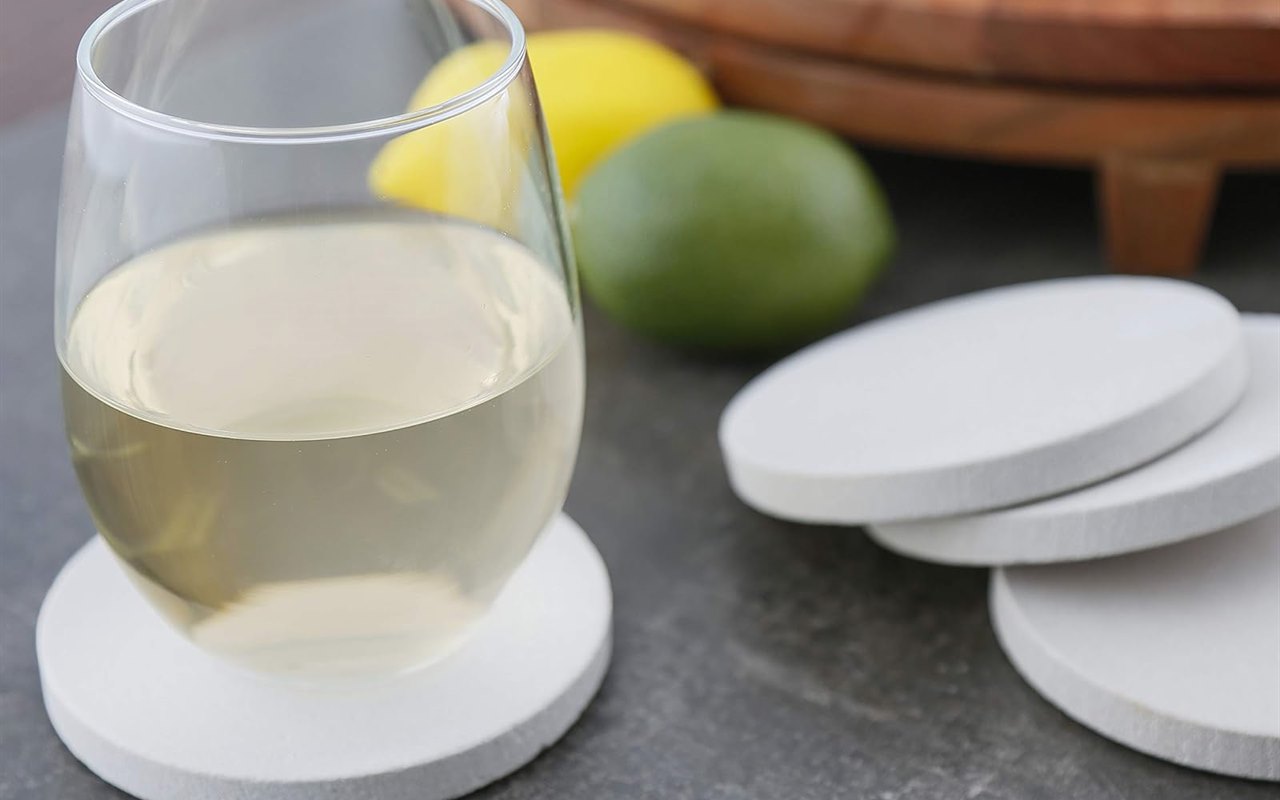
Thirstystone cuts coasters from porous sandstone, so condensation is pulled into the stone instead of pooling under your glass. 11,019 ratings across the range say the tables underneath stayed clean.
Porous sandstone·Cork backed·No two alike·Made in the USA lines·Wipes clean·Porous sandstone·Cork backed·No two alike·Made in the USA lines·Wipes clean
Why stone, not cork
A water ring is a transfer, not a spill
The mark left on a table is not the drink. It is condensation: water pulled out of the air onto a cold glass, running down to the base and sitting against the finish until it works its way in. Most coasters put a barrier in the way and let that water pool on top. Then the coaster comes up stuck to the bottom of the glass, which is where the cork and plastic ones lose you.
Sandstone does something different. It is a sedimentary rock, quartz and mica and feldspar and clay pressed into layers, and the gaps between those grains behave like a sponge with a very slow appetite. Condensation gets drawn off the glass into the body of the stone, spreads out inside it, and leaves again as the coaster dries. The table never meets the water. The glass never sticks.
How the discs are cut explains something else. Each one goes across the bedding rather than along it, so every coaster exposes a different band of the deposit it came from. Those pale stripes and rust lines are geology showing through, not a print.
Quartz, mica, feldspar, clayThe mineral grains that make the stone porous
4-inch faceStandard across the range; the embossed set is 4¼"
Cork baseIsolates the stone and stops the coaster sliding
Air dries between drinksThe absorbed water leaves on its own
Set finder
Three questions, one set
Eight sets on this page and most people need exactly one of them. Tell us about your table.
Collection 01
Bare sandstone
Nothing printed on the face, just the stone. The banding you see is the rock's own bedding, and that is why the four in a box never match. To see what sandstone actually does, start here.
Desert Sand Coaster Set
4" round · set of 4 · natural sandstone
★★★★★ 4.7 · 4,040 ratings
The one the brand is known for. Cut from natural sandstone, so the banding across each coaster is geology rather than print. No two in the box match. Four inches across, and thick enough to feel like stone when you set a glass down.
Natural sandstone, every piece patterned differently
The plainest set we make. Pale unfigured sandstone, full cork base, no design on the face. Buy this one when you want the absorbency without a pattern competing with your tableware.
The same absorbent stone with a design fired into the face: herringbone, botanical, cartography. The print does not change how the coaster works. It decides which table it belongs on.
Herringbone Coaster Set
4" round · set of 4 · herringbone print
★★★★★ 4.6 · 984 ratings
A slate-toned herringbone laid over the stone face. From across the room it reads as texture. Up close it turns into a tiny tiled floor. Good on a plain table that wants one detail on it.
A watercolour dragonfly over meadow grass, printed on pale stone. Made in the USA. People buy this one as a gift and then order a second set for themselves.
A 17th-century double-hemisphere map wrapped across four stones. The border text runs right to the edge, so the four read as one object when they sit together. Warm sepia on pale sandstone.
The outliers. One is stone pressed into relief rather than printed. The other two swap absorbency for stainless steel and cast iron, which is a different answer to the same water ring.
Victorian Lace Embossed Set
4¼" round · set of 4 · embossed relief
★★★★★ 4.7 · 1,504 ratings
Not printed. Pressed. The scrollwork stands up off the face and you can feel it with a thumb, in plain unglazed white stone. Made in the USA and boxed for gifting, which is most of why it costs what it does.
The non-porous answer. Stainless catches condensation in the rim instead of drinking it, and wipes clean in a second. Hot mugs are no problem either. Six coasters, plus a holder that keeps the stack tidy.
Cast iron with a scrolling bronze finish and felt on the base. It takes any four coasters between 4 and 4¼ inches, in stone, cork or ceramic, so it works with every set on this page and most of the ones you already own.
Desert Sand Coaster Set — the numbers and the complaints
Four thousand people have written about this set. Below are its real measurements, the three things they keep saying, and the case for buying something else.
★★★★★ 4.7 from 4,040 ratings · $21.54
Measured, not estimated
Diameter
4 inches (101 mm)
Thickness
Just under ⅜ inch, thick enough to feel like stone rather than a tile
Weight
About 3.5 oz per coaster; a boxed set of four is roughly 1 lb
Material
Natural sandstone: quartz, mica, feldspar and clay
The most repeated observation by far, usually from somebody who did not quite believe the claim before it arrived. People describe the same test every time: a cold glass, a warm room, then lifting it after an hour and finding the underside dry. Capillary action, if it needs a name. The pores pull water in faster than it can pool, and the coaster darkens a little while it holds it.
02
"They do not match, and that is fine"
The second theme is surprise that four coasters out of one box look like four different objects. Blame the rock's bedding. The banding runs through the block, and each cut takes a different slice of it. A minority of buyers want four identical faces and are briefly disappointed. For them the printed and embossed sets work better, because those are consistent piece to piece.
03
"Red wine left a mark"
This one comes up often enough that burying it would be dishonest. Porous stone takes in whatever is on it, and dark pigment is no exception. Wine, coffee and turmeric can all leave a shadow if they sit. A baking-soda paste lifts most of it if you get there within a day. If red wine goes over in your house regularly, buy the stainless set instead. Better you read that here than discover it in a month.
Who should skip it. Buy something else if you want four faces that match, if the set will live somewhere red wine gets spilled and forgotten, or if it has to survive a dishwasher. Those are real limits of porous stone rather than manufacturing faults. The embossed set solves the first one. Stainless solves the other two.
In use
On actual tables
The stone, the prints and the relief, photographed where they end up. Click any photo to open it full size.
Scroll sideways →
Where they end up
Six situations, six different answers
The right coaster depends less on your taste than on who is using it, and on what happens when nobody is watching.
Entertaining at home
Six people, one coffee table, three hours
The scenario the material was built for. Cold drinks sweat hardest in a warm room full of people, and nobody lifts a glass to check what is happening underneath. Absorbent stone takes the water as it runs down and gives it back to the air between rounds. The table survives the evening and nobody has to think about it.
A desk coaster gets more use than any other one in the house, and you look at it all day. Put the plain pale set here. It sits quietly against most desk finishes, takes a hot mug without complaint, and the full cork base stops it skidding when you reach for the handle.
Porous stone and unsupervised guests are a bad combination. One glass of red left overnight and the mark stays. Stainless is the sensible choice here. Six of them, non-porous, and if one goes through the dishwasher or vanishes into a suitcase, replacing it costs almost nothing.
Coasters are the safest thing on any gift list, because everyone needs them and nobody buys them for themselves. Both the botanical and the map sets arrive gift-boxed, and neither one forces a decor decision on the person opening it. They look considered rather than like a placeholder.
Stone is happy enough outdoors. The problem is grit. A coaster that lives on a patio collects dust under the cork, and that is the one thing that will scratch a table. Keep the set stacked in the iron holder between uses, and brush the undersides off every few weeks.
Shared kitchens punish anything that needs care. Steel needs none: a paper towel and it is done. The matching holder is what keeps them from scattering across three desks by Wednesday. Buy the six, put the holder next to the kettle, forget about it.
Both ship gift-boxed and neither commits the recipient to a strong decor style
Straight comparison
Sandstone vs. stainless vs. cork
Three ways to keep a glass off the wood. We make two of them, so read the last row before taking our word for anything.
Absorbent sandstoneOur signature
Stainless steelAlso ours
Cork or plastic
What happens to condensation
Drawn into the stone, released as it dries
Sits on the surface until it runs off
Soaks in and stays in
Water rings on the table
Prevented. The water never reaches the wood
Prevented, but the puddle has to go somewhere
Prevented until the cork saturates
Hot mug
Fine
Fine
Fine, but scorches over time
Red wine, coffee, turmeric
Can stain. It is porous stone
Wipes off completely
Stains permanently
Cleaning
Damp cloth, mild soap, air dry
Any way you like, dishwasher included
Wipe only; replace when soft
Lifespan
Years. It is rock.
Effectively indefinite
A year or two before it goes soft
Honest weakness
Stains from dark liquids, and needs to air dry
No absorbency at all. It is a tray
Short life, and sticks to glasses as it ages
If your household runs on red wine and espresso and nobody is going to baby a coaster, buy the stainless. We would rather sell you that than watch a sandstone set stain in a month. Cork is cheap and it works, for about a year.
Before you spend anything
Six questions people ask us about the cheap sets
All of these turn up in the inbox in some form, usually with a link to a four-dollar set attached. Answered as straight as we can manage while selling the alternative.
01Why does a stone coaster cost more than a set of four for six dollars?
The cheap sets are almost always ceramic tile or thin cork with a printed face, and both fail in their own predictable way. The tile absorbs nothing, so the water just runs off the edge. The cork goes soft and starts lifting off the bottom of glasses inside a year. Here you are paying for a piece of cut rock with cork bonded across the full base. Whether that is worth the difference comes down to one thing: do you want the water gone, or do you just want something under the glass.
02Is "absorbent stone" just marketing for ordinary ceramic?
No, and you can check it in about ten seconds. Put a few drops of water on a ceramic tile coaster and they bead up and sit there until you wipe them off. Put the same drops on natural sandstone and they sink in, leaving a dark patch that fades as the stone dries. Glazed ceramic has no open pore structure at all. It is a small plate.
03How do I tell a fired print from a sticker before I buy?
Look at the edge of the pattern in the listing photographs. A fired or pressed design carries on into the texture of the stone and follows its bumps. An adhesive transfer sits above the surface with a visible film boundary, usually a shade glossier than the stone around it. On the map set here the design runs over the rounded edge of the coaster, which a flat transfer cannot manage.
04Do the printed sets absorb less than the plain ones?
Slightly, and only over the printed area. The core is the same sandstone, and the untreated back and sides still breathe, so in practice a printed set handles a sweating glass no differently. For maximum absorbency, the bare stone sets have nothing on the face at all.
05Are the 4¼-inch coasters worth the jump in price?
Only for two reasons. Either you drink from wide-bottomed pint glasses and large mugs, or you want the embossed relief, which is a different object from a printed face. For standard glassware that extra quarter inch does nothing you will notice, and the 4-inch sets do the same job for a third of the price.
06What actually fails first on a coaster set?
On cork sets it is the cork. It compresses, goes fuzzy, and starts coming up stuck to cold glass. On cheap tiles the printed face crazes and the felt dots drop off. On stone sets nothing structural fails at all. What changes is the look, as dark liquids slowly darken a well-used coaster. That is the trade you make when you choose porous stone, and it is why we sell stainless alongside it.
Care guide
Keeping them working
Porous stone has two enemies: standing water it never gets to release, and a dishwasher. Five rules, and a set outlasts the table it sits on.
01
Wipe with a damp cloth
Warm water, a soft cloth, and mild dish soap if something sugary dried on. Ten seconds, and that is the whole routine.
02
Let it air dry flat
Leave it face up on the counter until it goes back to its original colour. A coaster giving up the water it absorbed is the material working, not a problem. Just do not stack them while they are still damp.
03
Never put stone in the dishwasher
Sustained heat and detergent are hard on porous stone, and they will lift the cork backing off. The stainless set is the only one here that belongs in a dishwasher.
04
Treat a stain early
For wine or coffee that has soaked in, make a paste of baking soda and water, leave it on the mark for an hour, then rinse and air dry. Repeat once before giving up on it.
05
Keep the cork clean
Grit caught under the cork is the only realistic way one of these scratches a table. Brush the undersides off now and then, especially if they live on a patio.
Damage & warranty
A chip, a crack, or cork lifting at the corner
Stone chips. That is the one failure worth planning for, and most of what goes wrong with a coaster set can be put right at the kitchen table in under ten minutes. Here is the order we would work through before anyone opens a claim.
What the warranty covers
Two years against manufacturing faults: cork coming away on its own, a crack present on arrival, a print that lifts.
Not covered: staining from wine, coffee or turmeric, damage from a dishwasher, or chips from a drop. Porous stone stains, and we say so on every page here.
How to claim: email hello@ with a photo of the fault and roughly when the set arrived. Sets bought through our retail partner are covered by their returns policy for the first month, which is usually faster.
01
Stop using it wet
Set the damaged coaster aside and let it dry out completely, face up, for a full day. Judging a chip in damp stone is guesswork, because the colour and the edge both change as it dries.
02
Work out which kind of damage it is
An edge chip is cosmetic and the coaster still works. A crack running across the face will split it in two sooner or later. Cork lifting at one corner is the most common problem and the easiest to put right.
03
Re-bond lifted cork
A thin bead of clear PVA or contact adhesive along the lifted section, pressed flat under a stack of books overnight, holds for good. Do not use superglue. It goes brittle and telegraphs through the cork as a hard ridge.
04
Smooth a chipped edge
Fine wet-and-dry paper, 400 grit or higher, used damp and with light pressure. Work around the whole rim rather than just the chip so the profile stays even, then rinse and air dry.
05
Retire a cracked one honestly
A coaster cracked through is finished as a coaster. It makes a decent plant pot base, where nobody minds the seam. Replace it rather than persisting, because a cracked edge under a glass is a scratch waiting to happen.
Plain definitions
The vocabulary, without the quarry mystique
Twelve terms that turn up on this page and in every other listing for stone coasters. Two minutes if you are comparing sets.
Sandstone
A sedimentary rock formed from sand grains compacted and cemented over geological time. What makes it useful as a coaster is not the grains but the space between them, which is open enough to hold water.
Porosity
The share of a material's volume that is empty space. Coaster-grade sandstone runs roughly 15–25%, which is why one of these can take on a surprising amount of condensation and still feel dry to a fingertip.
Capillary action
What does the work. Water climbs into narrow pores against gravity because it is more attracted to the pore walls than to itself. It is the same effect that moves water up a paper towel.
Bedding (banding)
The visible layering left behind as sediment was laid down season after season. Cutting across those layers is what gives each bare sandstone coaster its own pattern of stripes, and why no two in a box are alike.
Quartz grain
The hard, near-transparent grains that make up most of the rock and give it its wear resistance. Quartz is what stops the surface abrading under a glass base.
Feldspar
A second common mineral in the mix, softer than quartz and prone to weathering into clay. Feldspar content is part of why sandstone colours range from pale cream to warm rust.
Clay matrix
The fine material filling gaps between the larger grains. Too much of it and the stone stops breathing. The lots we buy are chosen for an open matrix that still holds together.
Cork backing
The layer bonded to the underside. It does two jobs: keeping cool stone off a finished surface, and stopping the coaster sliding when a glass is lifted off it.
Embossing
Pressing a relief pattern into the stone face rather than printing on top of it. A pressed pattern cannot wear off, because it is the shape of the surface rather than a layer sitting on it.
Fired print
A design bonded into the face under heat rather than applied as a transfer or sticker. It survives cleaning and it does not peel at the edges, which is what an adhesive print eventually does.
Non-porous
The opposite approach, used by the stainless sets. Nothing gets absorbed. Condensation collects in a rim and you wipe it away. No maintenance, no absorbency.
Trivet
A larger stone or metal pad meant to take a hot dish off a table. Related to a coaster but not interchangeable, because a 4-inch disc under a heavy casserole concentrates heat and weight at its edges.
The short version
One idea, forty years of it
Thirstystone started from something anyone who has owned a wooden table works out eventually: the coaster is usually the problem. Cork goes soft and lifts off with the glass. Plastic traps a puddle. Ceramic moves the water somewhere else and calls it solved. All three treat condensation as something to block.
Sandstone treats it as something to absorb. Once the brand committed to that, the rest followed on its own: cork backing so the stone never touches the wood, a 4-inch face sized to real glassware, printed and embossed lines for people who want the function without the quarry look. Stainless and cast iron came later, for rooms where absorbency is the wrong answer. The name is a joke about a coaster being thirsty, and it has outlasted several redesigns.
01Sandstone is quarried and cut into 4-inch discs across the bedding
02Faces are finished; printed lines take their design at this stage, embossed lines are pressed
03Cork backing is bonded to isolate the stone from the table
04Sets are boxed in fours and gift-ready, because most of them are gifts
Who answers the email
Small team, strong feelings about water rings
Three people, three parts of the job. The photo on each card shows the work rather than the person: the lot, the line, the question that keeps arriving.
RS
Rosa SalinasStone sourcing
Picks the quarry lots. The bare sandstone sets have the banding they do because she turns down stone that cuts too uniform.
A lot she kept. The banding runs differently on every piece
EK
Errol KnightFinishing
Runs the print and emboss lines. Argues, correctly, that a pressed pattern outlives a printed one by about a decade.
A pressed face off the emboss line, straight out of the press
JM
Jo MbekiSupport
Answers hello@. Built the set finder above out of the three questions she was retyping every day.
The exact question she gets most: does the print stop it absorbing
Verbatim
From tables in daily use
I have had the same four on the coffee table for six years. They have taken sweet tea, wine and one memorable spilled bloody mary, and they look exactly like the day they arrived. The wood underneath is unmarked, which was the entire point.
Bought these because our old cork ones had gone soft and started sticking to glasses. These have never once come up stuck to the bottom of a glass. The herringbone is quieter in person than in the photos, which I prefer.
Gave a set to my mother and immediately regretted not keeping them. The pattern is pressed into the stone, not printed on. You can run a thumb over it. Ordered a second set for us the same week.
Office kitchen, twelve people, no patience for maintenance. Steel was the right call. A wipe with a paper towel and they are done, and the holder means they get put back instead of scattering across three desks.
The map wraps around the edge of each stone, which I did not expect from the listing photos. When the four sit together on the tray they read as one piece. Guests always pick one up.
Bought it for coasters from a completely different brand and it fits them perfectly. Heavy enough that it does not skate around, felt on the bottom so it does not mark. Simple thing, done properly.
Asked constantly
Questions worth a real answer
How does a sandstone coaster actually stop a water ring?
It takes the water in rather than letting it sit. Sandstone is a porous sedimentary rock, made of quartz, mica, feldspar and clay grains with gaps between them. Condensation running down a glass gets drawn into those gaps instead of pooling underneath and transferring to your table. The stone lets it go again as it dries.
Will the coaster stay wet, or go mouldy?
They dry out on their own between drinks, and that cycle is what the material is built around. Trouble starts when you stack them away damp, or leave them in a closed box after a party, so let them air dry flat first. If one darkens and stays dark, it is still holding moisture and needs a day out on the counter.
Sandstone or stainless steel — which should I buy?
Sandstone if you want the water gone. It absorbs, and it looks like stone on the table. Stainless if you want no maintenance at all: the condensation stays in the rim, a cloth clears it, hot mugs are fine and nothing stains. Households with red wine and small children tend to be happier with the steel set. Everyone else usually prefers the stone.
My coasters have completely different patterns. Is that a defect?
No. On the bare sandstone sets that is rather the point. The banding is the rock's own bedding layers cut across, so each coaster carries a different slice of the same stone. Want four that match? The printed and embossed sets are consistent piece to piece.
Can I put a hot mug or a hot dish on one?
A hot drink, yes. Sandstone takes heat well and so does stainless. What we would not do is use a 4-inch coaster as a trivet for a casserole straight out of the oven. The stone will not fail, but a small disc under a heavy hot dish concentrates heat at its edges, and that goes into the table.
How do I clean them, and can they go in the dishwasher?
Damp cloth, mild soap, air dry. That is the whole routine for the stone sets. They should not go in the dishwasher, though: detergent and sustained heat are hard on porous stone and harder on the cork backing. The stainless set is the exception and washes however you like.
Will the cork backing scratch a polished table?
Cork is softer than any finish you are likely to have, which is why it is there. It keeps the stone off the wood and stops the coaster sliding. Keep the cork clean and dry. Grit trapped underneath is the only realistic way one of these marks a surface.
What fits the cast iron holder?
Any four coasters between 4" and 4¼" across. That covers every set on this page, plus most stone, cork and ceramic coasters from other brands. It is 5.13" square with felt feet, so it sits on wood without marking it.
Find us
Where Thirstystone works from
A small team in downtown Austin. There is no showroom. This is where the stone lots get judged and the support inbox lives.
Address411 Congress Ave, Suite 210 Austin, TX 78701
Your card details never touch this site. The buy buttons hand you over to the partner's secure checkout, and their buyer protection covers the order end to end.